CT Scan in Qatar | Preparation Cost and What to Expect
A CT scan provides detailed cross-sectional images of the body and helps doctors evaluate injuries, inflammation, bleeding, tumors, infections, and other medical conditions. Unlike a standard X-ray, CT imaging creates multiple images viewed in different planes, allowing physicians to examine internal structures in greater detail. CT scan in Qatar services may be recommended when a doctor needs more detailed information than can be obtained from a physical examination or another imaging test. The type of scan depends on the symptoms, the body area being examined, and the clinical information required. At Gardenia Medical Centre, radiology services are designed to support accurate diagnostic evaluation while helping patients understand the imaging procedure recommended for their individual needs.
What Is a CT Scan and When Might You Need One?
What Is a CT Scan?
A CT scan, also known as computed tomography, is a diagnostic imaging examination that uses X-rays and computer processing to create detailed cross-sectional images of the body. These images can be reconstructed into different views, giving radiologists a clearer picture of organs, bones, blood vessels, and other internal structures.
Compared with a conventional X-ray, CT scan imaging can provide more detailed information because it produces a series of images rather than a single projection. Depending on the area being examined, CT may help doctors identify internal bleeding, fractures, infections, tumors, blood vessel abnormalities, and other conditions. The appropriate imaging test is determined according to the patient's symptoms and the clinical question the physician needs to answer.[1, 2]
When Might You Need a CT Scan?
Doctors may recommend a CT scan in Qatar for a variety of diagnostic purposes. The examination can be useful when detailed imaging is needed to investigate symptoms, evaluate an injury, monitor a known condition, or clarify findings from another examination. Common reasons for requesting CT imaging include:
- Evaluating injuries after an accident or trauma.
- Investigating persistent or unexplained abdominal pain.
- Assessing suspected internal bleeding.
- Examining certain chest or lung abnormalities.
- Evaluating complex bone injuries.
- Investigating suspected tumors or abnormal growths.
- Assessing blood vessels in selected clinical situations.
- Supporting diagnosis when other imaging tests do not provide enough information.
The decision to perform a CT examination should be based on medical need. The World Health Organization emphasizes that medical imaging involving ionizing radiation should be justified according to the expected clinical benefit and optimized to use the lowest radiation dose necessary to obtain adequate diagnostic information.[3]
What Areas Can a CT Scan Examine and What Is Contrast?
Areas a CT Scan Can Examine
CT imaging can be used to examine many areas of the body, with the specific protocol selected according to the patient's symptoms and the information required:
- CT Scan for the Brain: Helps evaluate conditions such as head injuries, bleeding, certain strokes, skull fractures, and other abnormalities. In emergencies, head CT can provide rapid information that may help physicians make important treatment decisions.
- CT Scan for the Chest: Provides detailed images of the lungs, heart region, blood vessels, and other structures within the chest. It may be requested to investigate certain lung abnormalities, unexplained symptoms, infections, or other findings that require more detailed evaluation.
- CT Scan for the Abdomen and Pelvis: Provides detailed images of organs and structures within the abdominal and pelvic regions. It may be used when doctors need to evaluate abdominal pain, inflammation, internal bleeding, masses, or other suspected conditions.[4]
What Is a CT Scan With Contrast?
A CT scan with contrast uses a contrast material to make certain tissues, organs, or blood vessels more visible on the images. Depending on the examination, contrast may be administered intravenously or taken orally.
Contrast material does not produce radiation itself. Its purpose is to improve the visibility of selected structures and help the radiologist distinguish them from surrounding tissues.
Not every CT examination requires contrast. The decision depends on the body area being examined and the diagnostic information the physician needs. Before a contrast-enhanced examination, patients should inform the medical team about previous reactions to contrast material, relevant medical conditions, and other important health information.
Preparation, Procedure, and Safety Considerations
How Should You Prepare for a CT Scan?
Preparation depends on the type of CT examination. Some scans require little or no special preparation, while others may involve specific instructions regarding food, drinks, or contrast material. Before the examination, patients may be asked to:
- Follow fasting instructions if required.
- Inform the radiology team about a possible pregnancy.
- Mention previous reactions to contrast material.
- Provide information about relevant medical conditions.
- Remove jewelry or metal objects when requested.
- Follow any instructions provided by the radiology team.
If contrast material is planned, the preparation instructions may be different from those for a non-contrast examination. Patients should always follow the specific instructions provided for their examination.
What Happens During a CT Scan?
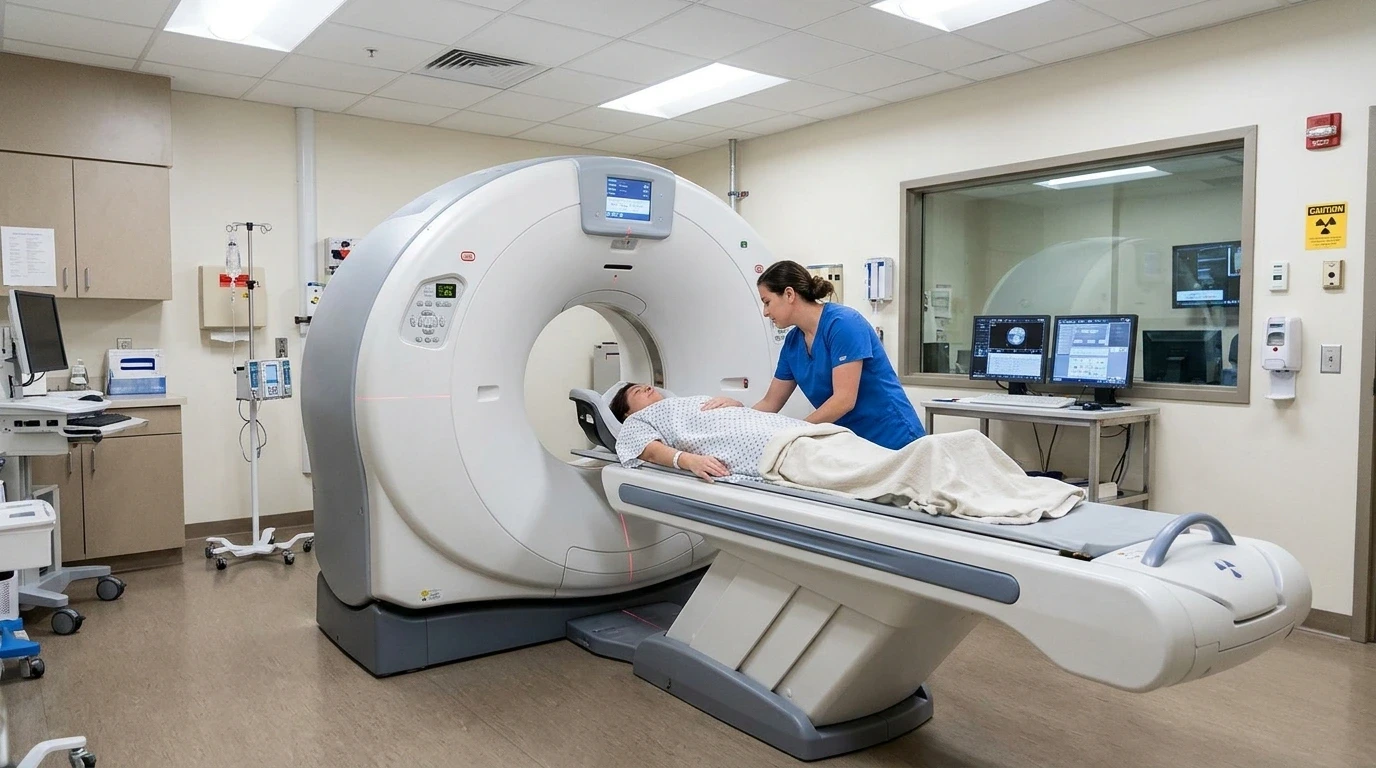
During a CT scan, the patient usually lies on a motorized table that moves through the CT scanner. The equipment uses X-rays to capture multiple images while the table moves through the scanner.
The examination is generally quick and noninvasive. Patients may be asked to remain still or briefly hold their breath during certain scans to help maintain image quality.
If contrast material is required, it may be given before or during the examination. Some patients experience a temporary warm sensation or another short-lived sensation after intravenous contrast is administered. Once the images are obtained, a radiologist reviews them and prepares a report for the referring physician.
Is a CT Scan Safe?
CT is widely used in modern medical imaging, but because it uses ionizing radiation, the examination should be performed when medically justified. The radiation dose varies according to the type of examination, the body area being scanned, and the imaging protocol.
Radiology teams use optimization principles to obtain the diagnostic information required while limiting unnecessary radiation exposure. This is particularly important for children and for patients who may require repeated imaging examinations.
Pregnancy should always be discussed with the doctor or radiology team before CT imaging. When imaging is medically necessary, the healthcare team can assess the benefits and potential risks and consider whether another examination, such as ultrasound or MRI, could provide the required information.
CT Scan vs. X-Ray: What Is the Difference?
Both CT and conventional X-ray imaging use X-rays, but they provide different types of information.
| Feature | CT Scan | X-Ray |
|---|---|---|
| Image Type | Produces multiple cross-sectional images | Usually produces a single projection image |
| Detail Level | Provides more detailed views of internal structures | Often provides a quick overview of bones and certain chest findings |
| Reconstruction | Can reconstruct images in different planes | Generally has a simpler image format |
| Clinical Application | May be used for complex diagnostic questions | Commonly used for routine imaging of bones and the chest |
The choice between CT and X-ray depends on what the physician needs to evaluate. CT generally involves more radiation than a standard X-ray, so it is not automatically preferable; the examination should be selected according to the clinical need. Patients who need conventional radiography can also explore Digital X-Ray Services as part of the radiology services available at Gardenia Medical Centre.[5]
CT Scan Cost in Qatar and How to Choose a Center
How Much Does a CT Scan Cost in Qatar?
The CT scan cost in Qatar can vary depending on several factors, including the body area being examined, the type of CT protocol, whether contrast material is required, and the specific medical facility. For example, a straightforward CT examination and a more specialized contrast-enhanced study may have different costs because they involve different imaging requirements.
Instead of choosing an examination based only on price, patients should first confirm which type of CT their physician has requested and whether contrast is needed. This helps ensure that the examination addresses the intended diagnostic question. For information about the current cost of a specific examination, patients can contact the radiology department directly and provide the requested scan details.
How to Choose a CT Scan Center in Doha
When looking for a CT scan center in Doha, patients can consider several practical factors beyond availability and cost:
- The qualifications and experience of the radiology team.
- The range of diagnostic imaging services available.
- Clear preparation instructions before the examination.
- Appropriate protocols for different clinical indications.
- Communication of results and radiology reports.
- The ability to coordinate imaging with other medical services when required.
Choosing a medical centre with a broader radiology service can also make it easier to access another imaging modality if the physician determines that a different examination would provide more useful information.
Diagnostic and Interventional Radiology at Gardenia Medical Centre
Gardenia Medical Centre provides diagnostic and interventional radiology services designed to support the evaluation and management of different medical conditions. The radiology department combines diagnostic imaging with specialized expertise to help physicians obtain the information required for patient care. For patients who require a CT scan in Qatar, the appropriate examination can be determined according to the clinical indication, body area, and information needed by the treating physician.

Dr. Abdelkhalik Mohamed Elghoul
Consultant in Diagnostic and Interventional Radiology | Head of Department
Dr. Abdul Khalek Mohamed El Ghol heads the Diagnostic and Interventional Radiology Department. He brings extensive experience in radiology and patient care, with particular expertise in complex vascular interventions.
His role within diagnostic and interventional radiology supports a multidisciplinary approach to imaging and selected image-guided procedures, helping connect diagnostic findings with appropriate clinical management when required.
Other Radiology Services Available at Gardenia Medical Centre
CT is only one part of diagnostic imaging. Depending on the patient's symptoms and clinical needs, the physician may recommend another imaging modality:
- Diagnostic Ultrasound (Sonography): Uses sound waves rather than ionizing radiation to create images of internal structures. It is commonly used for a range of diagnostic assessments and may be particularly useful when real-time imaging is needed.
- Digital X-Ray: Provides conventional radiographic imaging for different clinical indications, including selected bone and chest examinations.
- Pregnancy Ultrasound (Obstetric): Provides ultrasound imaging during pregnancy to monitor fetal development and assess pregnancy-related findings.
- Pelvic & Gynecological Ultrasound: Used to examine pelvic structures and support the evaluation of various gynecological conditions.
- Abdominal Ultrasound: Provides imaging of abdominal organs using ultrasound technology and may be recommended for specific abdominal symptoms or clinical findings.
- Thyroid Ultrasound & Imaging: Helps evaluate the thyroid gland and identify structural findings that may require further medical assessment.
The availability of several imaging options allows the physician to select the examination that best matches the clinical question. Ultrasound and MRI, for example, do not use ionizing radiation, while CT and standard X-rays do.
When Might Another Imaging Test Be More Appropriate Than CT?
CT is not always the most suitable imaging test. The appropriate modality depends on the body part, suspected condition, patient's age, pregnancy status, and the type of information needed. For example, ultrasound may be useful for certain abdominal, pelvic, thyroid, and pregnancy-related examinations. MRI can provide more detailed information for some soft tissues and does not use ionizing radiation. In other situations, a conventional X-ray may provide the necessary information with a simpler examination. This is why the decision should be based on a physician's clinical assessment rather than choosing an imaging test independently.[6]
When Should You Talk to Your Doctor Before a CT Scan?
Patients should discuss the examination with their doctor or radiology team before undergoing CT if they:
- Are pregnant or may be pregnant.
- Have previously experienced a reaction to contrast material.
- Have relevant medical conditions that may affect preparation or contrast use.
- Have undergone recent imaging examinations and are concerned about repeated radiation exposure.
- Are unsure whether the requested CT examination requires contrast or special preparation.
Discussing these factors allows the healthcare team to determine whether the planned examination is appropriate and whether any additional precautions are needed. WHO guidance emphasizes the importance of justification and optimization when medical imaging involves ionizing radiation.
Book Your CT Scan in Qatar at Gardenia Medical Centre
If your physician has recommended CT imaging, Gardenia Medical Centre can help you access its radiology services and understand the requirements for your examination:
- Explore our Diagnostic and Interventional Radiology services.
- Visit the Gardenia Medical Centre Contact Page for more information about available imaging services.
- Book your appointment online through the Online Appointment Booking Page.
Frequently Asked Questions About CT Scan in Qatar
What Is a CT Scan?
A CT scan is a medical imaging examination that uses X-rays to produce detailed cross-sectional images of different areas of the body. The doctor determines whether a CT scan is needed based on the patient's symptoms and medical evaluation.
Is a CT Scan in Qatar Painful?
A CT scan in Qatar is a non-invasive examination and does not usually cause pain. Some patients may experience a temporary warm sensation or mild changes in how they feel when contrast material is injected.
When Does a CT Scan in Doha Require Contrast?
A doctor may recommend contrast material for certain CT scans in Doha to provide clearer images of tissues or blood vessels. However, not all CT examinations require contrast.
Can You Have a CT Scan During Pregnancy in Qatar?
You should inform your doctor in Qatar if you are pregnant or may be pregnant before having a CT scan. This allows the medical team to assess whether the examination is necessary, weigh its potential benefits and risks, and consider an alternative when appropriate.
What Is the Difference Between a CT Scan and an MRI in Qatar?
A CT scan in Qatar uses X-rays to create detailed images, while MRI uses a magnetic field and radio waves. The doctor determines which examination is more appropriate based on the body area, medical condition, and diagnostic information required.