Your Smile, Restored.
Dental Implants in Qatar: The Complete Guide to Making a Confident Decision
Many patients ask me whether they should keep repairing a failing tooth or finally opt for a permanent replacement. It is an incredibly common dilemma. You might currently be dealing with a severely damaged tooth, navigating an exhausting cycle of temporary fillings, crowns, and root canals, while wondering: "Should I keep trying to save this tooth, or is it time to consider dental implants?"
What I always tell my patients in the clinic is simple: there is no single answer that fits everyone, but there are clear medical facts you must weigh before deciding. In this comprehensive guide, developed by our clinical team at Gardenia Medical Center, we will walk you through everything you need to know about dental implants in Qatar. We will break down the differences between saving a compromised tooth and replacing it altogether, helping you make a choice that aligns with your health, lifestyle, and peace of mind.
What are Dental Implants? Understanding the Basics
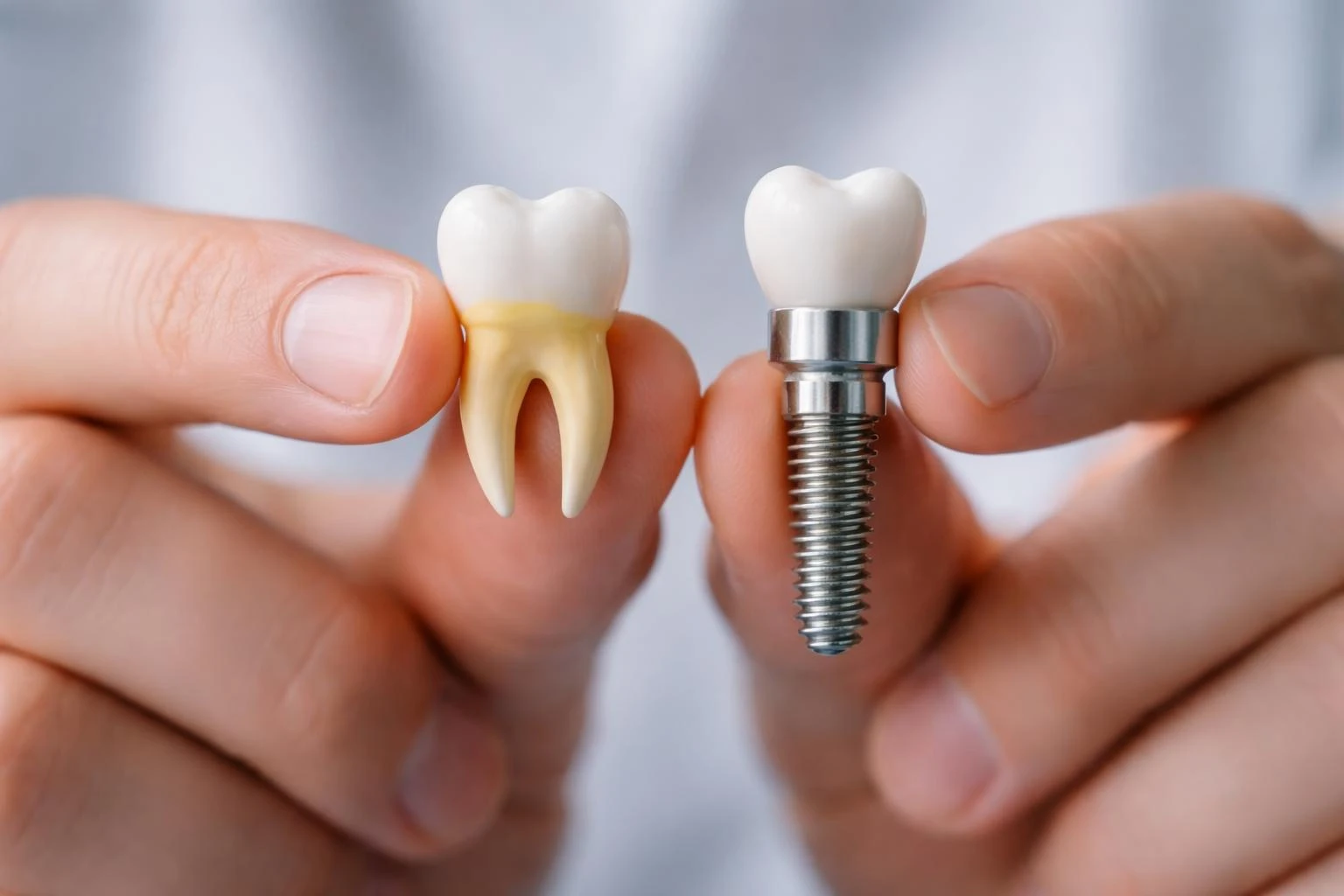
At our dental clinic, we view dental implants as one of the most significant advancements in modern restorative dentistry. Simply put, an implant is a permanent, natural-looking replacement for a missing or failing tooth that looks, feels, and functions just like the real thing.
Medically, a dental implant is a small, bio-compatible post—typically made of high-purity titanium—that a specialized dentist surgically places directly into the jawbone. Titanium is exceptionally strong, lightweight, and uniquely capable of fusing with human bone without causing allergic reactions or degradation.
Over a period of a few months, a remarkable biological process called osseointegration (bone fusion) occurs. The surrounding bone grows tightly around the titanium post, securing it as a rock-solid anchor. Once this fusion is complete, a custom-made ceramic crown (such as high-translucency E-max or durable Zirconia) is fixed on top.
Clinical Perspective: Think of the implant as your new, hidden root beneath the gumline, and the crown as the visible tooth above it. The final result blends so seamlessly with your remaining natural teeth that no one will ever notice a difference in appearance or function.
The Traditional Cycle of a Failing Tooth
Before deciding on teeth replacement in Doha, it helps to understand how a tooth typically degrades over time. In clinical practice, we often find patients trapped in a repetitive, multi-stage cycle:
- Composite Fillings: This is the first line of defense against minor decay. While highly effective for small cavities, a filling does not alter underlying genetic or environmental risks for future decay.
- Root Canal Treatment: When decay penetrates the deep nerve center (the pulp), a root canal is required to eliminate pain and preserve the physical structure, but it leaves the tooth more brittle over time.
- Dental Crowns: A crown is placed over the root-canal-treated tooth to protect it from fracturing under biting forces. While crowns can last for years, the underlying tooth structure remains vulnerable to hidden decay.
- Repeated Failures & Retreatments: Over time, old restorations can leak or break down. Patients often find themselves dealing with recurrent infections, root fractures, or failed previous root canals.
- Tooth Extraction: When a tooth can no longer be structurally or biologically saved, extraction becomes the unavoidable final step.
- Choosing a Replacement: This is where the patient must choose between an independent dental implant, a traditional bridge, or a removable partial denture.
In many cases, patients realize too late that they have spent more money, time, and emotional energy on a sequence of temporary repairs for a single failing tooth than they would have spent on a definitive, long-lasting dental implant.
When to Seriously Consider Dental Implants in Qatar?
If you are wondering whether it is time to transition from temporary fixes to permanent restoration, look for these clinical indicators:
- You already have a missing tooth: Or your dentist has confirmed that an existing tooth has a non-restorable fracture or severe bone loss and must be extracted.
- Recurrent treatment failure: You find yourself returning to the clinic repeatedly for the same problematic tooth without achieving lasting stability.
- Financial tipping point: The cumulative costs of future root canals, build-ups, and replacement crowns begin to outweigh the price of a single implant.
- Silent bone loss: You have noticed a change in your facial structure or gum architecture. Every month a tooth space is left empty, the jawbone undergoes a silent process of resorption (melting away). Implants are the only treatment capable of halting this bone loss by stimulating the bone.
- Impaired quality of life: The missing or painful tooth is actively changing how you chew, causing you to avoid certain local foods, or making you feel self-conscious when smiling in social or professional settings in Doha.
The Hidden Consequences of Delaying Treatment
A common patient misconception corrected clearly in our practice is the belief that leaving a gap in your smile is merely a cosmetic issue that can be put off indefinitely. In reality, delaying a dental implant carries significant oral and systemic health risks:
- Jawbone Atrophy: The moment a tooth root is lost, the surrounding bone begins to diminish due to lack of mechanical stimulation. If you wait too long, you may lack the necessary bone volume for a standard implant, requiring advanced bone grafting surgeries later.
- Teeth Drifting and Misalignment: Teeth rely on each other for structural support. When a gap is left open, the neighboring teeth will slowly tilt and drift into the empty space, while the opposing tooth may over-erupt. This destabilizes your entire bite and creates hard-to-clean spaces prone to severe periodontal disease.
- Temporomandibular Joint (TMJ) Disorders: An uneven bite forces your jaw muscles and joints to compensate during chewing, which frequently leads to chronic jaw pain, clicking sounds, and tension headaches.
- Digestive Inefficiency: Missing crucial chewing teeth forces you to swallow poorly chewed food, shifting an unnecessary metabolic burden onto your digestive system.
Overcoming Common Fears About Dental Implants
It is completely natural to feel anxious about undergoing a dental procedure. Let us address the most frequent concerns with modern clinical facts:
Is the Procedure Painful?
Dental implant surgery is performed under highly effective local anesthesia, meaning you will not feel any pain during the procedure. Most patients report that getting an implant involves far less discomfort than a standard tooth extraction. Any mild, post-operative swelling or tenderness over the following few days is easily managed with standard prescribed over-the-counter medications. For patients experiencing severe dental phobia, Gardenia Medical Center provides conscious sedation options to ensure a completely stress-free experience.
What if the Implant Fails?
Globally, dental implants maintain an exceptional success rate of 95% to 98% when performed by an experienced specialist. Implant failure is incredibly rare and is typically not caused by the body "rejecting" the titanium, but rather by specific lifestyle factors such as heavy smoking or uncontrolled diabetes, both of which impair local blood flow and healing.
Addressing the Financial Investment
While the upfront cost of dental implants in Qatar is higher than a bridge or denture, it represents a highly cost-effective, lifelong investment. Because implants do not require routine replacement or maintenance every few years, they save you significant money over the long term. To make treatment highly accessible, our center offers flexible payment and installment options.
The Treatment Duration
Traditional implant healing typically takes between 3 to 6 months for complete osseointegration. However, advanced clinical tech now allows for immediate dental implants Qatar (immediate loading) in select cases. This means a damaged tooth can be extracted, the implant placed, and a beautiful temporary crown attached all within a single visit, ensuring you never have to leave the clinic with a gap in your smile.
Clinical Protocol: Pre-Op Preparation and Post-Op Care
Achieving an optimal, lifelong result requires careful adherence to clinical protocols before and after your surgical appointment.
Before Your Procedure
- Comprehensive Assessment: Undergo a high-definition 3D Cone Beam Computed Tomography (CBCT) scan. This allows your specialist to map your bone density, nerve pathways, and sinus locations with micrometric accuracy.
- Periodontal Stabilization: Ensure that any underlying gum inflammation or active infections are treated beforehand to establish a completely sterile surgical field.
- Lifestyle Adjustments: A specific Qatar/Gulf lifestyle note to consider is the impact of heavy smoking or shisha use on oral wound healing. You must completely stop smoking at least one week prior to surgery, as nicotine restricts blood flow to the gums and significantly lowers bone integration success.
Your Practical Home-Recovery Instructions
- Dietary Management: For the first 7 days following surgery, stick entirely to soft, cool, or room-temperature foods (such as smoothies, yogurt, and pureed soups). Avoid hot beverages, spicy local dishes, and hard or crunchy foods that could disrupt the surgical site.
- Oral Hygiene: Do not brush the immediate surgical site directly for the first few days, but keep the rest of your mouth immaculately clean. Use a soft-bristled brush, floss your other teeth gently, and rinse with a warm salt-water solution or a prescribed antiseptic mouthwash starting 24 hours post-surgery.
- Activity Restrictions: Avoid strenuous physical exercise or heavy lifting for the first 3 to 5 days, as increased blood pressure can provoke localized bleeding at the implant site.
⚠️ When to Contact Your Doctor Immediately: While mild swelling and minor oozing are normal for the first 48 hours, you should contact our emergency clinic line immediately if you experience throbbing pain that does not respond to prescribed medication, a sudden spike in body temperature, or persistent numbness in your lip or jaw lasting more than 24 hours after surgery.
Implant Modalities Available in Doha
Every patient's jawbone anatomy is unique, which is why we utilize a wide variety of specialized implant modalities:
| Implant Modality | Clinical Description | Ideal Candidate |
|---|---|---|
| Traditional Implants | Two-stage placement requiring a standard healing period for bone fusion before the final crown is placed. | Patients with adequate bone density seeking maximum long-term predictability. |
| Immediate Dental Implants | Placement of the implant post into the socket immediately following tooth extraction during a single session. | Patients with healthy surrounding bone who want to minimize treatment time. |
| Full-Mouth Reconstructions (All-on-4 / All-on-6) | A revolutionary technique where an entire arch of fixed teeth is securely anchored by just 4 or 6 strategically angled implants. | Patients with complete tooth loss or failing dentition who want to avoid individual implants. |
| Bone Grafted / Sinus Lift Implants | Implants placed following or alongside a bone augmentation procedure to rebuild lost bone volume. | Patients suffering from long-term bone atrophy or low sinus floors in the upper jaw. |
| Computer-Guided Digital Implants | Implants planned via 3D software and executed using custom, 3D-printed surgical templates. | Patients requiring highly complex placement or seeking minimally invasive surgery. |
Advanced Technology at Modern Dental Centers
The field of dental implantology has evolved rapidly. At elite practices, several key technological tools are utilized to elevate patient safety, comfort, and success rates:
- 3D Cone Beam Imaging (CBCT): Eliminates guesswork by providing an exact three-dimensional roadmap of your oral anatomy.
- Digital Workflow and Intraoral Scanners: Replaces old, uncomfortable mouthfuls of impression putty with a swift, highly accurate digital scan that instantly sends data to a CAD/CAM system for custom crown design.
- Platelet-Rich Fibrin (PRF): A technique where a small sample of your own blood is processed to isolate natural growth factors, which are then placed into the surgical site to dramatically accelerate tissue healing and bone regeneration.
- Advanced Dental Lasers: Used to gently contour gum tissue, minimize localized bleeding, and sterilize the surgical area, leading to minimal post-op swelling.
How to Choose the Right Implant Specialist in Qatar?
Because dental implant placement is a highly delicate surgical procedure, your choice of healthcare provider directly influences your long-term success. Look for the following professional benchmarks:
Specialist Qualifications and Experience
Ensure your provider is a licensed specialist in oral surgery, periodontics, or implantology, rather than a general practitioner performing surgeries occasionally. Ask about their clinical track record, specialized training, and request to see verified "before and after" photos of cases identical to yours.
Clinic Technology and Safety Standards
The facility should feature an integrated digital infrastructure, including dedicated surgical suites, strict adherence to international sterilization protocols monitored by the Ministry of Public Health in Qatar, and an experienced multi-disciplinary team capable of coordinating your care seamlessly under one roof.
Why Gardenia Medical Center is Doha's Premier Choice?
Gardenia Medical Center represents an established center of excellence for advanced dental care and dental implants in Qatar. We don't view implant surgery as just a clinical procedure; it is a transformative journey focused on restoring your self-confidence and systemic health.
Our dedicated department features:
- A highly respected team of internationally trained consultants and specialists with decades of combined surgical experience.
- An advanced, fully digital workflow featuring in-house CBCT diagnostics and state-of-the-art CAD/CAM restoration design for unmatched precision.
- A welcoming, patient-centric environment designed to alleviate dental anxiety through transparent education, empathetic care, and personalized sedation options.
- An exceptional track record of patient satisfaction, proudly reflected in our 4.9-star rating on Google from thousands of patients across Doha.
Our dental department is led by Dr. Kherallah Khalaf Abdul Rahim, Consultant in Restorative and Implant Dentistry. Dr. Kherallah brings world-class expertise to complex full-mouth rehabilitations, immediate placement protocols, and advanced bone preservation techniques, ensuring you receive the highest international standards of care right here in Doha.
Frequently Asked Questions (FAQ)
Is same-day dental implant surgery safe?
Yes, immediate dental implants are highly safe and predictable, provided the patient has excellent localized bone density and a healthy oral environment free of active periodontal disease. Your specialist will confirm your candidacy using a 3D CBCT scan prior to scheduling the procedure.
How should I prepare for my dental implant surgery?
Get a good night's rest before your appointment, eat a nutritious meal (unless you are undergoing conscious sedation, which requires fasting), and strictly follow any pre-operative medication steps prescribed by your dentist. Most importantly, you must stop smoking or using shisha at least one week prior to the procedure.
Can I drive myself home after the dental implant procedure?
If your surgery is performed under standard local anesthesia, you will be completely alert and safe to drive yourself home. However, if you choose conscious sedation to manage dental anxiety, you must arrange for a family member or friend to drive you home safely, as the sedative effects take a few hours to completely wear off.
Which cases are not suitable for dental implants?
Implants may not be initially suitable for individuals with unmanaged chronic illnesses (such as uncontrolled diabetes), patients undergoing active chemotherapy, or individuals with severe, untreated gum disease. In many cases, once the underlying condition is medically stabilized or gum treatment is completed, the patient can safely move forward with implants.
What symptoms should I watch out for at home after surgery?
While minor swelling and minimal discomfort are standard parts of the healing process, you should watch out for abnormal symptoms such as severe, throbbing pain that is not relieved by painkillers, continuous bleeding from the site, an unexpected fever, or a persistent numb sensation in your lips, chin, or tongue long after the anesthesia should have worn off. If any of these occur, contact the center immediately.
Medical disclaimer: This article is for educational purposes only and does not replace a consultation with a qualified healthcare professional. Please consult your doctor for an accurate diagnosis and a treatment plan suitable for your condition.